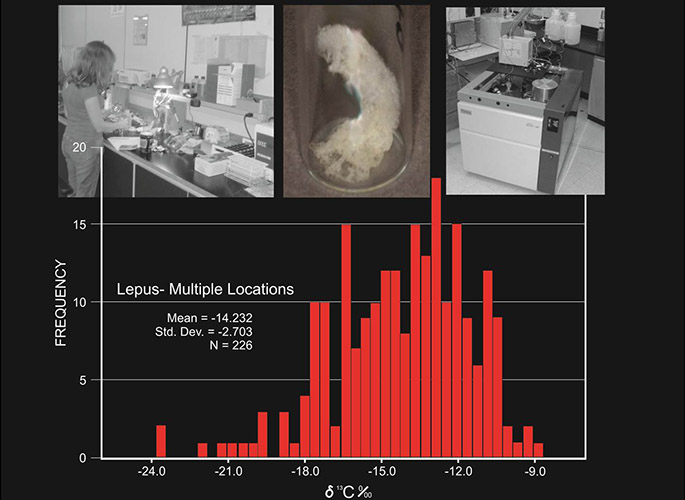
The Paleo-Research Laboratory (PRL) at CAR conducts a variety of activities focused primarily on isotopic research into past ecological conditions and prehistoric diets. We work with several laboratories and researchers including:
University of New Mexico, Center for Stable Isotopes
Dr. Debajyoti Paul, geochemist in the Department of Civil Engineering at the Indian Institute of Technology in Kanpur and Dr. Robert Hard in the Department of Anthropology at UTSA.
Dr. Steve Black in the Department of Anthropology at Texas State University.
CAR Center staff and students prepare a variety of plant, animal, and soil components for stable carbon and nitrogen isotopic assessments, including the preparation of bone collagen and land snail shell for radiocarbon dating. Additional information about the lab and ongoing research is available in this document about the PRL and from Dr. Raymond Mauldin (raymond.mauldin@utsa.edu) or Ms. Cynthia Munoz (cindy.munoz@utsa.edu).
For further information on isotopic research on paleodiet:
Mauldin, Raymond P., Robert J. Hard, Cynthia M. Munoz, Jennifer L.Z. Rice, Kirsten Verostick, Daniel R. Potter and Nathanael Dollar (2013). Carbon and nitrogen stable isotope analysis of hunter-gatherers from the Coleman site, a Late Prehistoric cemetery in Central Texas. Journal of Archaeological Science 40(2013):1369-1381.
Munoz, Cynthia M., Jennifer L.Z. Rice, Kirsten Verostick, Robert Hard and Raymond Mauldin (2013). A Stable Isotope Analysis of Hunter-gatherers from Hitzfelder Cave, Texas. Paper presented at the 116th Annual Meeting of the Texas Academy of Science, Kerrville.
Rice, Jennifer L. Zonker, Kirsten Verostick, Laura Carbajal, Cynthia Munoz, Nathanael Dollar, Robert J. Hard and Raymond P. Mauldin (2012). Stable Carbon and Isotopic Analysis of Human Remains from the Coleman Site (41BX568), A Late Prehistoric Occupation in Central Texas. Paper presented at the 115th Annual Meeting of the Texas Academy of Science, Alpine.
Verostick, Kirsten, Robert Hard, Cynthia Munoz and Raymond Mauldin (2012). Reconstructing Seasonal Diet in the Lower Pecos using Stable Isotopes in Human Hair. Presented at the 115th Annual Meeting of the Texas Academy of Science, Alpine.
Hard, Robert J. and M. Anne Katzenberg (2011). Stable Isotope Study of Hunter-Gatherer-Fisher Diet, Mobility, and Intensification on the Texas Gulf Coastal Plain. American Antiquity 76(4):709-751.
on paleoecology:
Smith, Stephen, Raymond Mauldin, Cynthia M. Munoz, Robert Hard, Debajyoti Paul, Grzegorz Skrzypek, Patricio Villanueva and Leonard Kemp (2014). Exploring the use of stable carbon isotopes ratios in short-lived leporids for local paleoecological reconstruction. Open Journal of Archaeometry 2:5306.
Mauldin, Raymond, Cynthia Munoz, Robert Hard, Stephen Smith and Steven Lukefahr (2013). Bunny Tales-Using Stable Isotopes from Short-Lived Leporids to Reconstruct Local Paleovegetation at Archaeological Sites. Paper presented at the Annual Meeting of the Texas Academy of Science, Kerrville.
Paul, Debajyoti and Raymond Mauldin (2013). Implications for Late Holocene climate from stable carbon and oxygen isotopic variability in soil and land snail shells from archaeological site 41KM69 in Texas, USA. Quaternary International 308-309 (2013):242-252.
Mauldin, Raymond, Cynthia M. Munoz, Leonard Kemp and Robert Hard (2012). Reconstructing Past Vegetation Types during the Late Holocene using Stable Carbon Isotopes of Leporids from Archaeological Sites in the American Southwest. Poster presented at the 45th Annual American Geophysical Union Meetings, San Francisco, California.
Paul, Debajyoti, Raymond Mauldin and Cynthia Munoz (2011). Inferences of Late Holocene climate from stable carbon and oxygen isotope ratio variability in soil and land snail shell from archaeological site 41KM69 in Texas, USA. Poster presented at the 44th Annual American Geophysical Union Meetings, San Francisco, California.
Smith, Stephen, Robert Hard, Raymond Mauldin and Cynthia Munoz (2011). Testing the Usefulness of Stable Carbon Isotopes in Short-Lived Leporids to Reconstruct Local Paleoecology. Paper presented to the 114th Annual Meeting of the Texas Academy of Science, Austin.
Munoz, Cynthia M., Raymond Mauldin, Robert Hard, Stephen Smith and Patricio Villanueva (2010). Reconstructing Fine-Grained Paleovegetation Shifts through Variation in Stable Carbon Isotopes of Leporids collected from Hunter-Gatherer Archaeological Sites in Central and South Texas. Poster presented at the 38th International Symposium on Archaeometry, Tampa, Florida.
other isotopic research:
Munoz, Cynthia, Patricio Villaneuva and Raymond Mauldin (2011). Exploring Diagenetic Alterations in Stable Isotopic Signatures in Bone Collagen. Poster presented at the 76th Annual Meeting of the Society of American Archaeologists, Sacramento, California.
on Hitzfelder Cave:
Mauldin, Raymond, Jennifer L.Z. Rice and Cynthia M. Munoz (2013). 41BX26, Hitzfelder Cave, Texas Background. Summary report, on file at the Center for Archaeological Research, The University of Texas at San Antonio.
Mauldin, Raymond, Robert Hard, Cynthia Munoz and Jennifer L.Z. Rice (2013). Stable Carbon (δ13Ccollagen, δ13Ccarbonate) and Nitrogen (δ15N) Isotopes from Radiocarbon Dated Hunter-Gatherers at Hitzfelder Cave, Texas. Poster presented at the 78th Annual Meeting of the Society of American Archaeologists, Honolulu, Hawaii.
Mauldin, Raymond P., Robert J. Hard, Cynthia M. Munoz, Jennifer L.Z. Rice, Kirsten Verostick, Daniel R. Potter and Nathanael Dollar (2013). Carbon and nitrogen stable isotope analysis of hunter-gatherers from the Coleman site, a Late Prehistoric cemetery in Central Texas. Journal of Archaeological Science 40(2013):1369-1381.
Munoz, Cynthia M., Jennifer L.Z. Rice, Kirsten Verostick, Robert Hard and Raymond Mauldin (2013). A Stable Isotope Analysis of Hunter-gatherers from Hitzfelder Cave, Texas. Paper presented at the Texas Academy of Science, Kerrville.
on the Clemente and Herminia Hinojosa Site (41JW8):
Mauldin, Raymond, Cynthia M. Munoz and Stephen L. Black (2013). Young bunnies and Old Wood: Reconsidering the Chronology at the Hinojosa Site (41JW8). Poster presented at the 84th Annual Meeting of the Texas Archeological Society, Del Rio.
Black, Stephen L. (1986). The Clemente and Herminia Hinojosa Site, 41JW8: A Toyah Horizon Campsite in Southern Texas. Special Report, No. 18. Center for Archaeological Research, The University of Texas at San Antonio.
on Macrophysical Climate Model (MCM):
Mauldin, Raymond P. and Cynthia M. Munoz (2013). Macrophysical Climate Models and Holocene Hunter-gatherer Subsistence Shifts in Central Texas, USA. Poster presented at the 46th Annual American Geophysical Union Meetings, San Francisco, California.
McDonald, H.G. and R.A. Bryson (2010). Modeling Pleistocene local climatic parameters using macrophysical climate modeling and the paleoecology of Pleistocene megafauna. Quaternary International 217:131–137.
Higgins, P. and B.J. MacFadden (2009). Seasonal and geographic climate variabilities during the Last Glacial Maximum in North America: Applying isotopic analysis and macrophysical climate models. Palaeogeography, Palaeoclimatology, Palaeoecology 283:15–27.
Bryson, R. A. and K. M. DeWall (2007). A paleoclimatology workbook: high resolution, site-specific, macrophsical climate modeling. The Mammoth Site of Hot Springs, South Dakota.
Ruter, A.H., J. Arzt, S. Vavrus, R.A. Bryson and J.E. Kutzbach (2004). Climate and environment of the subtropical and tropical Americas (NH) in the mid-Holocene: comparison of observations with climate model simulations. Quaternary Science Reviews 23:663-679.
Bryson, R.A. and R.U. Bryson (2000). Site-specific, high-resolution models of the monsoon for Africa and Asia. Global and Planetary Change 26:77-84.
Bryson, R. A. (1992). A Macrophysical Model of the Holocene Intertropical Convergence and Jetstream Positions and Rainfall for the Saharan Region Meteorology and Atmospheric Physics 47:247-258.
Bryson, R.A. (1988). Late Quaternary volcanic modulation of Milankovitch climate forcing. Theoretical and Applied Climatology 39:115–125.
Bryson, R.A. and B.M. Goodman (1986). Milankovitch and global ice volume simulation. Theoretical and Applied Climatology 37:22–28.
Also, see:
2015 Paleo-Research at Eagle Nest Canyon in the Lower Pecos-Ancient Southwest Texas Project