
Posted on October 21, 2026 by Nick Ward
UT San Antonio has launched the School of Communication, Language, & Culture which has combined the Department of Communication with the Department of Modern Languages & Literatures into a single, unified academic ecosystem.
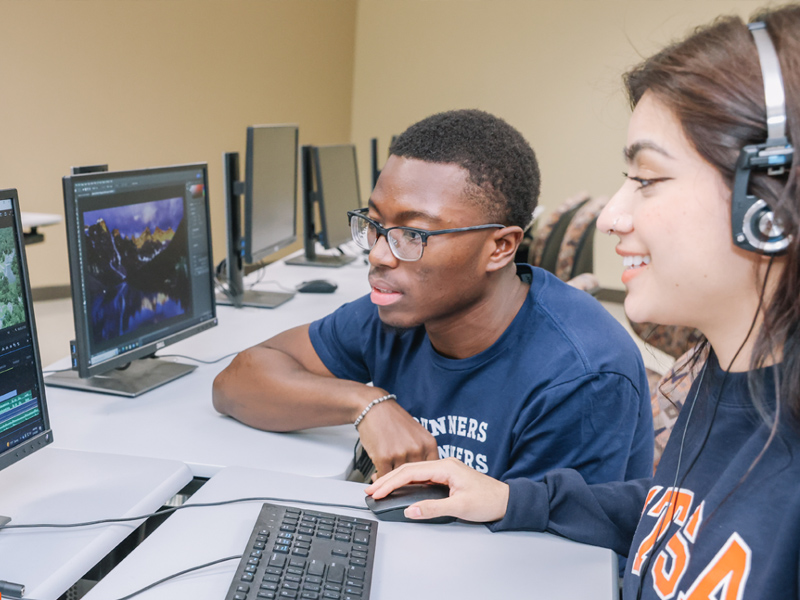
Communication students utilizing Adobe Creative Suite
As humans, our connection to one another relies entirely on a shared system of meaning. Communication provides the method to share ideas. Language provides the structure for those ideas. Culture provides the context that makes those ideas matter. You cannot isolate one concept from the others, as they operate as an interdependent system. COLFA looks to align curriculum with this reality by launching the new School of Communication, Language, & Culture, an integration of the Department of Communication with the Department of Modern Languages & Literatures.
By the numbers, the new school has tremendous reach. The school will serve over 1,000 undergraduate majors alongside 50 Master of Arts students. A doctoral program in Communication is at the last stage of UT System approval. Students will have the opportunity to pursue six residential Bachelor of Arts degrees, two fully online Bachelor of Arts programs, two Master of Arts degrees, and multiple certificates, including the new Certificates in Digital Communication and Health Translation and Interpreting. In addition, the new school will be supported by nearly 70 faculty members.
“We are building ‘A School Like No Other’ in the city of San Antonio,” said COLFA Dean Glenn Martinez. “The school builds on the strength of two already distinguished departments into a singular unit that expands the impact of what these two units already accomplish individually. We are actively investing in the next generation of global communicators.”
Integrated degree plans and faculty collaborations are in the works and will draw on the strengths of both areas. Many institutions across the United States already recognize the overlap between these fields, and international models offer a blueprint for integration. Throughout Europe, universities frequently merge language studies and professional communication into a single academic ecosystem. Instead of isolating language courses, these schools weave cultural training directly into degree pathways.
A strong example of this model includes the new Bachelor of Arts in Asia Pacific Studies. Pioneered by Professor of Instruction and Assistant Dean of Faculty Success Makiko Fukuda, the program will allow students to select Chinese, Japanese, or Korean language and cultural study.
The program emphasizes career readiness by focusing on language proficiency with technical training in a “language plus skills” framework. Through the Media, Arts, Languages, and Cultural Studies focus area, students apply regional knowledge to creative projects within media and entertainment fields through communication courses in digital media production. By not isolating either language or technical skills, students will be primed to explore a wide variety of careers in their culture of interest both domestically and internationally.
The curriculum continues to expand into career-focused pathways with COLFA’s minor programs. Professor of Translation and Interpreting Studies Melissa Wallace spearheaded two recently approved programs. Students can now minor in Spanish and Medical Humanities alongside a new minor in Spanish and Criminal Justice. These programs give graduates of any major a practical edge in fields where cultural fluency really matters.
Chad Mahood serves as the Interim School Director to guide the initial integration of the departments. UT San Antonio is currently conducting a nationwide search for an Inaugural School Director. This incoming leader will cement long-term goals for the school and recruit new faculty members to contribute to curriculum and research development.
“I served as the Comm Department Chair for the past four years, and during one of those years I also served as the Modern Languages Interim Department Chair,” said Mahood. “I know that some faculty in these former Departments already collaborate on important projects. I foresee even more amazing future collaborations in both research and teaching.”
This growth mindset extends into digital classrooms. Under Mahood’s leadership, the expanding number of online Bachelor of Arts in Communication majors now complements the online Spanish Multidisciplinary Focus Area. To support this expansion, Assistant Professor of Practice Elizabeth Olvera developed a new accelerated language schedule for the 2026-2027 academic year. COLFA will offer eight-week Spanish classes for both residential and online students. This format allows individuals to advance from elementary to advanced proficiency in just a single year.
Plans are in the works to amplify and build upon our existing research centers and units, such as the Communication Center for Dialogue and Deliberation, where students learn to appreciate and apply fundamental communication skills, tools, and techniques to improve their relationships and career readiness while also learning about community decision-making. Also with Communication, Digital Initiatives aims to be an academic forum for media- and data-driven storytelling advancing community engagement by integrating interdisciplinary collaborations with language and culture.
Modern Language and Literature’s Mexico Center is already in committee discussions about expanding its reach to cover all the Americas, as well as the Borderlands, for students interested in exploring their heritage along with new cultures.
A shared vision requires a shared home. COLFA plans to merge both departments within a single physical footprint. This environment will serve as a central gathering point for both departments and will include common areas that encourage conversations between students and faculty, technical spaces to engage in schoolwork and research, housing for specific centers, and spaces to host events centered around regional traditions. Spaces are currently being considered for final integration.
With the new school launching soon, COLFA is excited to explore the possibilities present when communication, language, and culture are merged into one interconnected ecosystem. Future graduates of the school will step into their careers recognizing this interdependent system and its importance to the human experience as they ready themselves to take on the careers of tomorrow.
— Nick Ward
