
Posted on October 21, 2026 by Nick Ward
The National Association of Medical Spanish (NAMS) and the Medical Organization for Latino Advancement (MOLA) convened for their joint annual conference at the UT San Antonio Downtown Campus. The gathering provided a forum for healthcare professionals, educators, students, and advocates to address barriers affecting Spanish-speaking communities, including disparities in cultural and language competencies across healthcare fields
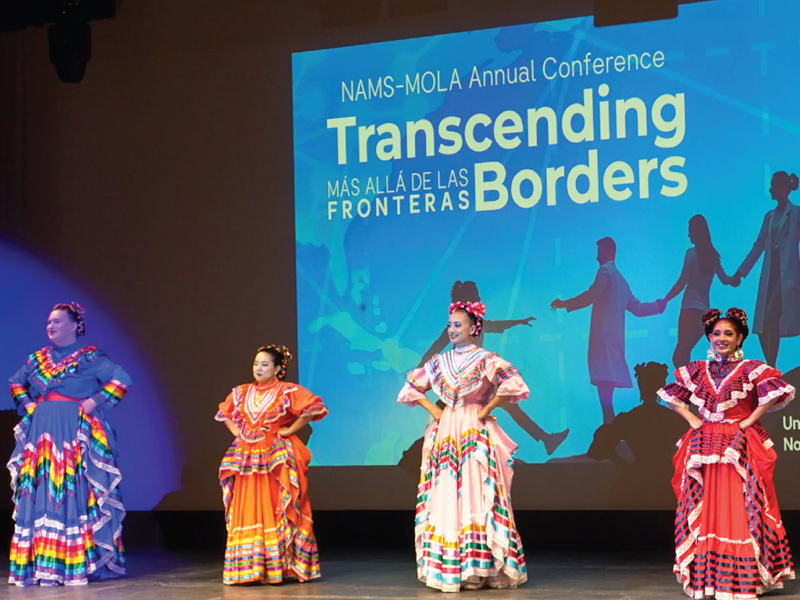
Ballet Folklórico de UTSA welcomes attendees to the conference.
NAMS-MOLA Conference in San Antonio
The National Association of Medical Spanish (NAMS) and the Medical Organization for Latino Advancement (MOLA) convened for their joint annual conference at the UT San Antonio Downtown Campus last November. The gathering provided a forum for healthcare professionals, educators, students, and advocates to address barriers affecting Spanish-speaking communities, including disparities in cultural and language competencies across healthcare fields.
The conference, themed “ Más allá de las fronteras” or “Transcending Borders,” featured sessions on a wide range of topics ranging from language access and education to policy advocacy. Assistant Professor Stephanie Brock Gonzalez was instrumental in planning to bring this important conference to UT San Antonio and executing it to the high standard it has achieved in Chicago with the 2025 conference being the first time it was hosted outside the windy city.
“Hosting the NAMS-MOLA Conference in San Antonio was an incredible opportunity because it was the first time this national gathering was held outside of Chicago. I had the privilege of collaborating with an incredible organizing committee representing institutions and healthcare systems from across the country,” shared Gonzalez. “Celebrating what makes San Antonio so special reminds us that cultural knowledge is not an add-on to healthcare, it is an essential part of providing meaningful, patient-centered care.”
The conference intentionally partnered with local Latino-owned small businesses to highlight some of the foods that are part of everyday life in San Antonio, including breakfast tacos, Texas barbecue, café de olla, conchas, and antojitos you might find at a neighborhood snack stand. Organizers were also thrilled for participants to experience performances by UT San Antonio’s Ballet Folklórico and Mariachi Morado, alongside music from the Latinoamerican Duo (violin and guitar), as well as taking part in a riverboat tour along the San Antonio Riverwalk.
Language professionals from within COLFA participated, including Dean Glenn Martínez, Professor of Spanish, Bicultural/Bilingual Studies and Public Health, who participated in a live recording of the NAMS Podcast titled “Talking Language Learning and How Multilingual Clinicians Can Thrive.” Hosted by NAMS President Pilar Ortega, MD, the live session brought together a diverse group of educators and clinicians to explore the daily realities of working in multicultural medical environments and the state of higher education.
“One of the things that I often tell my undergraduate students in the Spanish for Health Care Professionals course is that this is not about proficiency or how many words you know,” said Martinez. “It’s about relationships. That is what medical Spanish is about. It’s about how you take linguistic resources and use those to establish and nurture relationships for the long term.”
Melissa Wallace, Professor of Translation and Interpreting Studies at UT San Antonio, gave a talk titled “Book Clubs, Community Building, and Language Access: Collective Reading for Disruption in Uncertain Times.” This presentation started conversations around the polycrises currently being experienced in the realm of language access policy and aimed to turn participants’ awareness back to the pleasures of collective leisure reading as a civic strategy at a time where clinicians and medical interpreters, alongside their patients, are facing increasing communication challenges.
Multilingualism in medical care is a baseline requirement for addressing health disparities. Professionals and community advocates at the conference outlined the challenges faced by immigrants and non-English speakers when interacting with the healthcare system. Designated health disparity zones reveal systemic gaps in care. Rural agricultural workers living in work camps face vulnerabilities, including the extra labor required to translate medical information into multiple languages and a severe lack of options in where to seek care.
Recent data from health equity researchers stress the scope of these challenges. Nationwide, nearly 40 million people speak Spanish at home, yet a severe shortage of certified Spanish-speaking healthcare providers persists across the clinical landscape. As a result, patients regularly face prolonged wait times or depend on family members, often young children, to act as informal interpreters during complex medical consultations. Clinical studies confirm that unaddressed language barriers increase the risk of adverse medical events and reduce medication adherence, while also causing patients to delay necessary preventative care. Rural agricultural workers living in work camps are particularly vulnerable because they often lack language tools to meet their needs in communities outside major cities.
Effective care for Spanish-speaking patients demands an infrastructure that delivers accurate, culturally relevant medical communication without placing the translation burden on the patients themselves. Precision care across language divides involves understanding the patient’s regional background and community rather than applying a blanket translation approach.
“The conference reinforced why our work in the Spanish as a Heritage Language Program is so important. Heritage speakers bring valuable linguistic and cultural knowledge that can make a meaningful difference in healthcare and many other professional fields,” said Gonzalez. “Our goal is to build upon the skills students already possess while helping them develop confidence in academic and professional settings, allowing them to recognize their bilingualism as a strength and an asset.”
By supporting students in developing their language abilities while deepening their understanding of the communities they serve, COLFA is preparing graduates who can build connections and establish trust while communicating across linguistic and cultural contexts. Preparing graduates who understand both language and culture is one of the most meaningful ways we can serve San Antonio and the communities that call it home.
COLFA is helping to address the workforce demands discussed at the conference through academic pathways to train the next generation of language professionals. The Bachelor of Arts in Linguistics provides students with the analytical skills to understand language acquisition and structure. The Graduate Certificate in Health Translation and Interpreting Studies provides training for working within legal and medical environments. For students looking to add onto their existing degree plans, the recently approved Minor in Spanish and Medical Humanities leverages two high-quality programs into a program that can open doors in multiple fields.
Given San Antonio’s long history of navigating language and healthcare, the city remains a natural fit to host future NAMS-MOLA conferences. Looking ahead, the integration of UT San Antonio and UT Health positions the university to become a national hub for conversations in both healthcare and language, with COLFA students poised to become tomorrow’s experts.
— Nick Ward
