
Posted on October 21, 2026 by Nick Ward
For over 50 years, The University of Texas at San Antonio has led field research in Maya archaeology, uncovering how one of the ancient world's most complex societies lived and thrived. Led today by Professors M. Kathryn Brown and Jason Yaeger, UTSA's premier program navigates the demanding jungles of Belize and Mesoamerica to study Maya history spanning over two millennia.
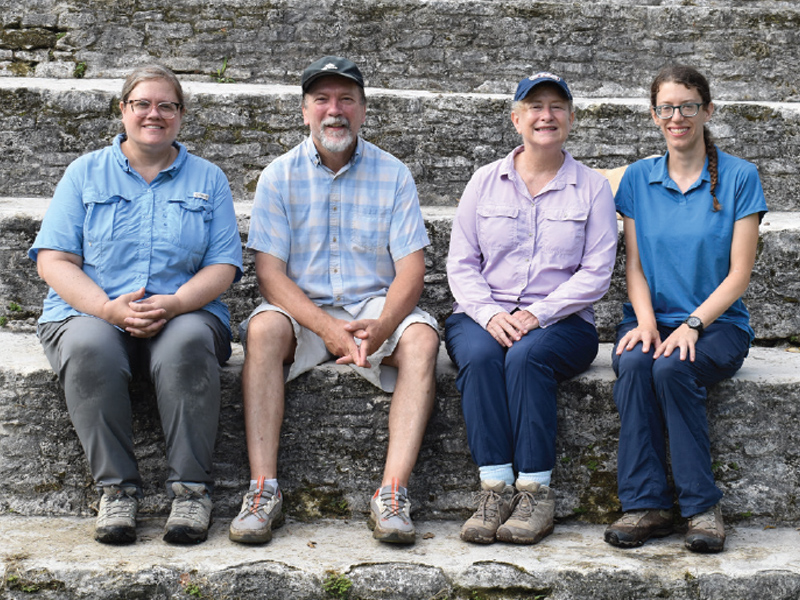
aeger and Brown (center) flanked by project Associate Directors, Bernadette Cap (left) and Rachel Horowitz (right) on the stairs of the main acropolis at the Maya site of Xunantunich, Belize.
“Is there anything left to dig?”
It is a question archaeologists hear regularly, with the thought that nearly everything worth finding has already been discovered. When discussing the ancient Maya civilization, the answer is a resounding “yes!” There is so much left to learn about how one of the most complex societies of the past not only lived but thrived. Maya civilization was a complex society with a long history, and documenting and reconstructing the history of this civilization requires a commitment to decades of continuous study.
Fieldwork in the region that was home to Maya civilization—southeastern Mexico, Guatemala, Belize, and parts of El Salvador and Honduras—demands physical and mental resilience. Hiking through the dense jungle is extremely taxing, as researchers navigate thick overgrowth and steep inclines to locate ancient settlements. The humidity and heat present constant challenges for the archaeological teams and their equipment. Despite the physical toll, the promise of discovery drives the university’s researchers forward.
This summer marked 54 years of field research in Maya archaeology for The University of Texas at San Antonio. Leading the charge today are Professors M. Kathryn Brown and Jason Yaeger. Together, they lead one of the premier Maya studies programs in the nation. Their combined efforts have reshaped our understanding of the ancient Maya, and they continue to bring global recognition to the university and unique hands-on research opportunities for our students.
A Foundation of Excellence
The roots of Maya archaeology at the College of Liberal and Fine Arts stretch back to the university’s first years. Richard E.W. Adams, the founding dean of the college in 1972, was a major figure in the field. His early advocacy established a strong foundation for Anthropology at UT San Antonio, and from his first year at UTSA until his retirement in 2005, he was an active researcher, most notably directing many years of research at the major city of Rio Azul, Guatemala.
Around the same time, Thomas R. Hester, founded the university’s Center for Archaeological Research (CAR), acting as its director for 13 years, from 1973 to 1987. Hester established CAR as one of the top cultural resource management programs in Texas, while also leading field schools in South Texas and Belize. Notably, he co-directed long-term excavations at the important Maya site of Colha, Belize.
Laura Levi, who joined UTSA in 2002, kept the university at the forefront of Maya research after Adams’ retirement. She directed fieldwork in Belize for many years, focused on the domestic economy of ancient Maya farmers and how they were organized into neighborhoods and communities. She recently retired, but she remains highly active, returning to Belize for research every summer and mentoring students from multiple universities.
Today, research on Maya culture continues at UT San Antonio through the work of M. Kathryn Brown, Jason Yaeger, and their graduate students. Their combined efforts are actively reshaping our understanding of this civilization.
M. Kathryn Brown serves as the Lutcher Brown Endowed Professor of Anthropology. She currently directs the Mopan Valley Preclassic Project in Belize. Her work explores the earliest settled villages in the Maya world, where she examines topics such as ancient ritual and religion while investigating the origins of a hierarchical social system. She asks questions about what types of activities supported the shifts that led to the origins of this advanced civilization.
Brown’s research tracks the origin of kingship across 1500 years of history. She studies the transfer of sacred knowledge from one generation to the next. Understanding religious pedagogy requires examining the specific institutions that maintained these beliefs. For instance, her work at the site of Las Ruinas de Arenal uncovered early jade offerings placed within a public space at the heart of this early community. She has documented early ancestor veneration practices, the study of which shows that ancient Maya people careful re-entered burial crypts to retrieve ancestral bones. Her work at the site of Xunantunich not only investigates ancient Maya ritual and religious practices across time but also examines how sacred knowledge was passed from one generation to the next. Her team has documented an ancient space of instruction, a school of sorts. Current UTSA PhD student, Lauren Nowakowski’s research examines the living spaces of these young Maya scholars in training.
Jason Yaeger serves as President’s Endowed Professor of Anthropology, and he studies Mesoamerican and Andean civilizations. Much of his research has investigated how Classic Maya rural communities were integrated into broader socio-political networks and institutions. He has excavated the houses of ancient Maya farmers, mapped agricultural terraces across Belize’s Mopan River valley, and excavated the ruler’s monumental palace at Xunantunich. Expanding his scope, he co-directed the San Pedro Maya Project to study how Maya immigrants from Mexico adapted to colonial British Honduras in the late 19th and early 20th centuries. He also led the Tiwanaku Inka Settlement Program, examining how the Inka Empire reconfigured monumental temples at that ancient city to create sacred spaces that legitimized their rule.
His current work examines the Mopan valley’s shifting political capitals to understand what factors led to the rise and fall of each in turn over the course of two millennia. For the last decade, he has been excavating a royal mortuary complex at the major site of Buenavista to document the establishment of the valley’s first royal house and understand how they stayed in power for two and a half centuries, before Buenavista was eclipsed by another regional capital, Xunantunich. He has shown how Buenavista’s divine kings and queens honored and celebrated their ancestors, communicating and interacting with them and other powerful supernatural beings through ritual practices, which in turn supported their own claims of divine rulership.
A Collaboration Built on Shared Passion
Brown’s first experience in Belize archaeology was in 1986, and Yaeger’s in 1990, but it was not until 2003 that they met, when they were both in Belize conducting archaeological research. At that time, Brown was an assistant professor at UT Arlington, and Yaeger was an assistant professor at the University of Wisconsin in Madison. Appropriately, they were married in a ceremony at the Maya site of Cahal Pech, Belize, and they both joined UT San Antonio’s Department of Anthropology in 2009 and 2010.
Since coming to UT San Antonio, each of them has maintained their research project in Belize. Together, they examine the rise and fall of Maya civilization, focusing on the roles of religion, economy, and warfare through time. Their research spans most of Maya history, from the earliest farming villages, through the Classic period when Maya society was governed by divine kings, to the historic period when Maya society responded to Spanish and
British colonialism.
Innovation through LIDAR Technology
Archaeology is constantly adopting new technologies. In 2012, Brown and Yaeger collaborated with other scholars on a grant for airborne LIDAR (Light Detection and Ranging) mapping of a large area in western Belize. With this technology, an instrument mounted on an airplane sends our laser pulses and measures their bounce-back to create a detailed map of the ground surface. Because many of those pulses penetrate the jungle canopy, LiDAR can quickly and accurately map hundreds of square kilometers of landscape in a few weeks, an effort that would take decades using traditional methods of cutting through the jungle and mapping sites on the ground.
The results of the LIDAR survey were astounding. The team found new sites hiding under the jungle canopy, and they identified fortifications and ancient roads that locals and archaeologists alike had unwittingly stepped over for generations. The incredible number of ancient house platforms revealed a very dense population, and the landscape was heavily transformed with terraces and other field systems to produce the food needed to support that dense population. Ancient communities marked their connections by aligning their sacred buildings, despite being separated by 5 kilometers. Furthermore, the LiDAR survey revealed the region’s geomorphology, revealing relic channels and oxbow lakes, areas where the Mopan River once flowed. The LiDAR data have provided the foundations for decades of additional research in the region.
Sustaining Traditions and Local Partnerships
Living and working in the same region for over three decades, Yaeger and Brown have developed strong ties with the local community of San Jose Succotz, where many residents are of Maya descent. They hire dozens of local men and women each summer, many of whom have decades of archaeological excavation experience.
This relationship extends beyond excavations, however. Their projects host the Succotz Archaeology and Heritage Day each summer, which is attended by hundreds of community members. The event brings together their projects and other collaborators (including the Belize Institute of Archaeology, other archaeology projects, local universities, and cultural groups) to share information about archaeology and celebrate the region’s cultural heritage. The event keeps cultural traditions alive including traditional music and dances and the ancient Maya ballgame called pok-ta-pok, where teams use only their hips to volley a rubber ball back and forth.
Tourism is very important to the local economy, and Belizean tour guides take great pride in providing guests with the most up-to-date information. Brown, Yaeger, and their graduate students also give presentations each summer to the local tour guide associations to share with them the latest findings.
When the COVID-19 pandemic closed the country for tourism, the local economy suffered greatly. Brown and Yaeger spearheaded a GoFundMe campaign that raised over $24,000 for food assistance that supported over 100 families in western Belize whose livelihoods depended on the income from archaeological fieldwork and tourism.
Mentoring the Next Generation of Scholars
Mentoring is a core component of the Brown and Yaeger’s research in Belize. Their undergraduate field school offers a rigorous, hands-on experience that allows students to participate directly in producing archaeological data that sheds new light on the ancient Maya. Eight MA students and 12 PhD students from five different universities completed their degrees on the project, with others currently in progress.
Their graduate students have been highly successful. For example, Zoē Rawski utilized her experience to secure a position at the American Museum of Natural History in New York. Another, Tiffany Lindly, is the Alamo Archaeologist. And Whitney Lytle is the Director of Scholarships at the Worthington Foundation in Maine. Lytle remains so dedicated to Maya archaeology that she uses her personal vacation time to return to Belize for two weeks of excavation each summer.
Building the Future of Maya Research
Since arriving 17 years ago, Brown and Yaeger have worked to add the next chapter to the long history of Maya research at UT San Antonio. In 2010, they founded the annual South-Central Conference on Mesoamerica, which brings together researchers from diverse disciplines who study ancient and contemporary indigenous cultures of Mesoamerica. The conference rotates through the region’s universities, but UT San Antonio has hosted five times.
They have also built collaborations with partner institutions in San Antonio. They consulted with the Witte Museum when it hosted the exhibit “Maya: Hidden Worlds Revealed” in 2016. Then in 2021, they teamed up with Bernadette Cap and the San Antonio Museum of Art to create the exhibit “Nature, Power, and Maya Royals,” which showcased artifacts from Yaeger’s excavations of the royal tombs, the very first time these objects were on public exhibit.
They envision a bright future for Maya research in Belize and beyond, growing the program with continued grants and donor support. Maintaining the high level of graduate student mentoring remains a top priority, and they want to continue recruiting top-quality students.
“There could not be a better time to study Maya civilization. We can now read Maya hieroglyphs very well, LiDAR is revolutionizing our understanding of how the ancient Maya transformed their landscape, and new tools like ancient DNA and AI are poised to push the field forward. But the foundations of our knowledge are still the data we collect by basic fieldwork - mapping and excavating archaeological sites and analyzing artifacts,” said Yaeger. “We are so excited for the future of Maya archaeology and for the next generation of Mayanist scholars being trained at UT San Antonio!”
To learn how you can support this research or get involved with the Department of Anthropology at The University of Texas at San Antonio, please visit the department’s official website. Students interested in applying for the next Belize summer cohort should contact Brown and Yaeger via email at Jason.Yaeger@utsa.edu and Kathryn.Brown@utsa.edu.
— Nick Ward
