
Posted on October 21, 2026 by Nick Ward
Through a partnership with the University of Urbino, UT San Antonio faculty Susan Rosenberg and Molly Zaldivar established an international archaeological field school in Fossombrone, Italy.
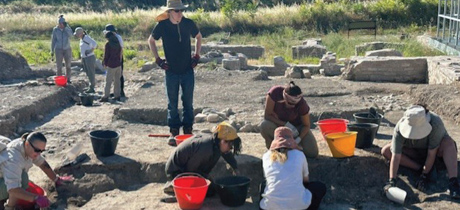
Archaeology students Tanya Campbell, Nicholas Castro, Eva Fountain, Mia Kaepp, Hayden Rockov, and Angelica Perez excavate the central area of the Roman building at Forum Sempronii
In the middle of the Italian countryside, the ground in the tiny town of Fossombrone holds secrets that have remained buried for centuries. Trowels scrape against compacted earth as students carefully expose hidden artifacts that date back to the second century BCE. Across the site, conversations flow back and forth between languages. A question delivered in English is quickly met with an Italian response with both parties practicing their multilingual skills. As the UT San Antonio students and faculty integrated into the daily life of the town, the excavation has become a permanent bridge between the university and the local community.
The foundation for this active dig began two years ago. Susan Rosenberg, an Associate Professor of Practice in the Department of Philosophy and Classics, and Molly Zaldivar, a Professor of Instruction in the Department of Modern Languages and Literatures, were teaching at the COLFA in Urbino summer study abroad program. They wanted to design a classical studies course rooted directly in the Marche region of Italy.
During a ride through the Italian countryside, the two spotted a sign for an archaeological park and decided to investigate further. With some quick research and the help of a mutual connection, they were quickly introduced to the director of the archaeological museum in Fossombrone. Rosenberg and Zaldivar visited his office to propose a collaboration. Within minutes, Site Director Doctor Oscar Mei of the University of Urbino met with the team to discuss the possibilities.
This meeting led to the first joint archaeological project between UT San Antonio and the University of Urbino. The initiative highlights the expansive potential of international collaborations. Establishing partnerships with foreign institutions provides students with distinct, hands-on learning environments and exposes them to experiences they could not experience back at home.
“This collaboration expands COLFA’s global footprint through a partnership that benefits both our faculty and our students,” said Dean Glenn Martinez. “By establishing formal ties, the team has created pathways for our college to engage in meaningful fieldwork while working to set a standard on how we collaborate with international communities.”
This is not the first field school to be developed at COLFA. Faculty lead several active initiatives across Latin America. Rebecca Bria works alongside local communities in Peru to uncover the history of ancient agrarian villages. In Ecuador, Michael Cepek partners with the Cofán Nation to navigate environmental changes. The college also sponsors an established summer program in Belize, where Jason Yaeger and Kathryn Brown guide students through the excavation of Classic Maya settlements. These programs offer a distinct advantage by turning coursework into applied fieldwork.
In Italy, building a field school for over 16 students required extensive coordination and proved to be quite the logistical challenge. Fossombrone is a quiet municipality lacking dormitories or large hotels. Local officials from the Chamber of Commerce worked closely with faculty to secure accommodations. They identified an unlikely, but functional solution in a family-run restaurant with available rooms upstairs. This setup allowed them to comfortably house 16 students for the duration of the trip.
“Being surrounded by a different culture truly opened my eyes in a refreshing way and helped me to appreciate the welcoming community around me. The people around us were patient and kind, which really helped the students to assimilate into a life that was similar yet very different from our home country,” said UT San Antonio student and participant Eva Fountain. “I cannot stress enough how amazing this trip was for me as it exceeded all of my expectations from learning to social interaction to experiencing the beauty of Italy.
The field school attracted participants from various academic backgrounds. From within COLFA, students from the Departments of Philosophy and Classics, Anthropology, and History joined the excavation. Engineering and computer science majors also participated. The program welcomed anyone willing to learn, though the directors prioritized students who had a specific academic need for the experience.
“In addition to the excavation itself, [the directors] organized meaningful and engaging side trips that enhanced our understanding of the historical and cultural contexts of our fieldwork,” said Anthropology Graduate student Tanya Campbell. “These experiences were intentionally researched and designed to build upon our coursework and to deepen our learning in ways that could never be replicated in a traditional classroom.
While Rosenberg managed the excavation, Zaldivar handled daily operational planning. With her background in languages, Zaldivar served as the primary Italian translator and cultural liaison. Zaldivar also took groups of students out to dinner at a communal table multiple nights a week. During these meals, students had the opportunity to actively practice their conversational Italian which could be put right to use the very next day at the dig.
In her Italian Immersion course at the UT San Archaeological Field School at Forum Sempronii course, Molly Zaldivar required each student participating in the dig to: 1) keep a notebook with Italian vocabulary and phrases learned and used each week both on site and in daily dealings with locals around town; 2) eat dinner with her once per week to discuss experience with Italian language, as well as ask questions about vocabulary and phrases; and 3) Provide a final response paper where they wrote about how learning Italian and using the language enhanced their experience in this small town where not everyone spoke English.
The immersion into Italian history and culture extended beyond the excavation site through weekend field trips helped provide students with additional context for the local history. The cohort traveled to Rome to explore historical landmarks, to Rimini to tour Roman sites there (a physician’s house, a Roman arch and a bridge built by the Romans. During one excursion to Fano, Rosenberg and the students even had the opportunity to attend a traditional Roman festival, “Fano of the Caesars.”
La Fano dei Cesari is an annual festival celebrating the Roman origin of Fanum Forunae, the ancient city of Fano. For several nights, the city is transformed into a Roman city with markets, parades, shows, and traditional foods. UT San Antonio students attended in 2025 and learned the Roman methods for making fire and blowing the Roman war trumpet but also got to meet with Roman enthusiasts who taught them about ancient perfumes and sandal making. The experience brought to life the very world that they were excavating in Forum Sempronii. For a day, Roadrunners got to be ancient Romans and thus their cultural knowledge increased which improved their analysis skills on site.
The relationship between the UT San Antonio group and the Fossombrone community grew significantly over the summer. Local archaeologists were initially unsure of what to expect from the visiting cohort. Lorenzo, an archaeologist on the site, was highly protective of the excavation area at the beginning of the term, but by the end of the program, the entire team were hosting karaoke nights together. Rosenberg continues to communicate with the local partners on a regular basis.
UT San Antonio has been invited back to Fossombrone to continue work with future cohorts. Building on their initial successes, Mei has already proposed that the next cohort shift their focus to excavating a nearby amphitheater.
In 2027, UT San Antonio will have its second season of the field school at Forum Sempronii, with Professors Rosenberg and Zaldivar continuing to teach field archaeology, Roman history, Italian language and culture. The project will start approximately June 19 and run through July 21. Students with any major can apply through the UT San Anton Study Abroad portal. Interested students can also stop by the Study Abroad Fair on September 8 and give their name and email address to the faculty member, who will send them an email regarding an information session for the project to be held later in September. Both faculty members can be contacted via email, susan.gelb@utsa.edu and molly.zaldivar@utsa.edu.
— Nick Ward
