
Posted on October 21, 2026 by Nick Ward
The College of Liberal and Fine Arts (COLFA) makes Roadrunners. The college has experienced unprecedented growth, with the number of students declaring a COLFA major growing by nearly 30% over the last three years.
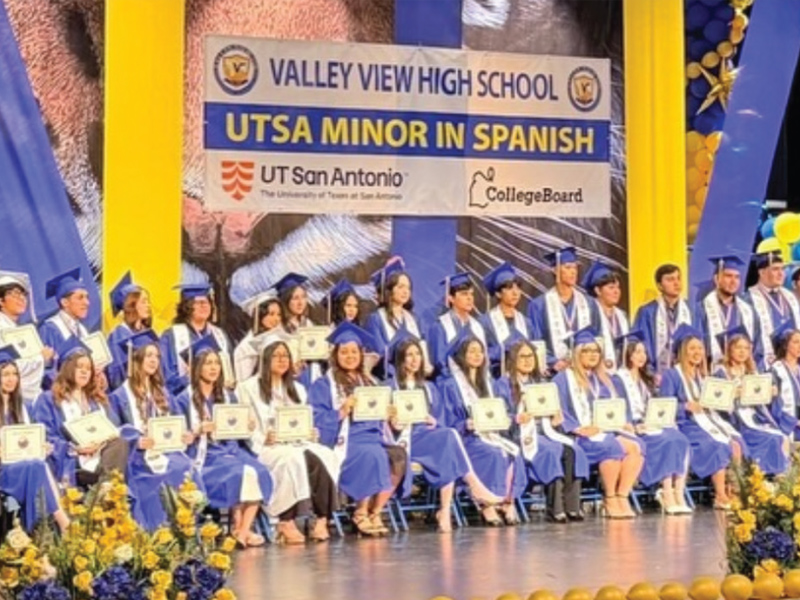
Graduating class of the Valley View High School Dual Credit program.
COLFA Makes Roadrunners
When did you feel that pull? That special spark of interest that empowered you to seek out your career. Many think students wait until senior year to sit down at a table and select “that one” from a numbered list, but we all know passion can arrive long before being forced to make a decision on a college entrance application.
The College of Liberal and Fine Arts (COLFA) makes Roadrunners. The college has experienced unprecedented growth, with the number of students declaring a COLFA major growing by nearly 30% over the last three years. Every department and school in the college experienced overall enrollment gains over the past year, pushing current enrollments to an all-time high. Programs seeing the largest surges include Art, Music, Communication, Film / Media, Dramatic Arts, Medical Humanities as well as the college’s online degree paths.
This momentum extends directly into graduate studies. Over the past several years, master’s and doctoral student enrollment increased by 2.1%, growing from 337 registrations in the 2023-2024 school year to 344 in 2026-2027. New degree and certificate options continue to strengthen these advanced studies, specifically the MFA in Film / Media, the MFA in Community Arts, the Certificate in Digital Humanities, and the Certificate in Digital Communication. Alongside this rapid expansion in new students, COLFA has also maintained gradual, steady increases in retention and graduation rates over the last five years.
This growth comes at no surprise because of efforts by the college to consistently reach out into the community and work with potential and future students to provide opportunities to learn new skills and find their motivation, sometimes in the most unexpected of places.
Early exposure often determines whether a student’s higher education aspirations become reality. Nationwide, pre-collegiate academic outreach is a powerful catalyst for college enrollment. Research from Harvard University’s Center for Education Policy Research shows that structured early outreach programs increase the likelihood of college attendance by 8.9 to 14.9 percentage points. The impact is most profound among traditionally underserved and first-generation students, particularly those from lower-income backgrounds, where targeted outreach and early exposure can double a student’s responsiveness to applying and enrolling. By bridging the information gap early, these initiatives actively dismantle systemic barriers and prove that cultivating a college-going mindset is essential to building UT San Antonio’s next generation of scholars. COLFA channels this strategy through a variety of programs and community outreach efforts to reach local talent early, showing them that a vibrant, world-changing future as a Roadrunner is well within their grasp.
Spanish Dual Credit
COLFA is helping high schoolers get a head start on earning college credit through the Early Birds Spanish Minor Academy. Since the 2023-2024 academic year, 349 students have participated in the academy, and eighty-eight of those students successfully completed their Spanish minor before graduating high school.
The initiative reaches students across South Texas, with participating campuses including Valley View High School in Hidalgo and South Side High School in San Antonio. Alexander High School and United High School in Laredo have also recently joined the program.
Students typically begin the coursework during the spring of their sophomore year. To enroll, they must score a 3 or higher on the AP Spanish Language Culture Exam or pass a district-issued language test. They take one college level course for credit each semester until graduation.
A defining feature of the academy is a one-week summer residency on the university campus right before the students begin their senior year.
The curriculum teaches Spanish as a heritage language. Many participants grew up speaking Spanish at home, so this approach validates their cultural background and strengthens their academic language skills. Participants are held to the same expectations as undergraduate students. High school facilitators are placed in the classrooms to provide daily guidance and ensure the students succeed with the advanced material.
Healthcare interpretation serves as a core focus of the minor. Students take an intensive course covering medical terminology and communication strategies. Upon completion, students can receive a certificate qualifying them to sit for national certification exams like the CCHI or NBCMI. Earning these credentials early gives students a distinct advantage for future employment in the healthcare industry.
This year, the program expanded with half of the dual credit students taking medical interpreting and the other half, new this year, took an introduction to legal interpreting taught by Melissa Wallace and Michelle Pinzl.
One of the best aspects of the program is that financial barriers are completely removed for many participating families. The state’s FAST program covers tuition for students qualifying for free or reduced-price lunches. School districts step in to cover any remaining fees. This zero-cost structure helps show students that a university education is an attainable goal and is an opportunity worth working hard for.
Mariachi
UT San Antonio’s Mariachi program is growing under the guidance of Director Michael Acevedo. Acevedo spent 14 years teaching middle school before transitioning to his role at the university. He now directs several of his former middle school students who enrolled at UT San Antonio. He also organizes a springtime vocal competition for younger students, an event that provides participants with feedback from a combination of university voice faculty and professional mariachi performers.
The UT San Antonio Mariachi program, Mariachi Los Paisanos, recently expanded to two full groups with 45 to 50 members each. Acevedo often recruits by inviting high school students from areas such as Kyle and San Marcos to attend university recitals. He also builds relationships with regional school directors so they feel comfortable recommending their students to UT San Antonio.
Mariachi plays an interesting role as compared to many traditional music students as many participants do not pursue music as a primary career. Students studying subjects like Engineering or Accounting often add a music minor so they can teach private lessons after graduation. Others participate to perform professionally. The mariachi scene in San Antonio is exceptionally active, and students can earn $50 to $60 an hour playing gigs while pursuing their degree.
For students who are interested in mariachi and a career path in education, UT San Antonio is launching a new degree concentration for the BA/BM in mariachi music education starting this fall. The curriculum swaps traditional requirements for mariachi-specific courses, such as harmonium and methods focusing on guitar and guitarrón. Several incoming students have already chosen UT San Antonio specifically for this degree path.
String Project and the School of Music
Mariachi is not the only music program that the School of Music is using to connect with area youth. The UT San Antonio String Project introduces children to music while removing financial barriers to arts education. Operating for over two decades and as a network member of the National String Project Consortium, the program provides low-cost instruction on orchestral stringed instruments and classical guitar to community students in third through eighth grade. By introducing instrumental education years before most public school programs begin, the project gives San Antonio students a valuable head start in their artistic development. This early exposure to a university campus helps younger students realize that learning an instrument can translate directly into a professional career in music as either a performer or instructor.
The initiative also serves as a training ground for future music educators. Undergraduate and graduate students from the School of Music teach the community classes under the supervision of master teachers and university faculty. This structure allows UT San Antonio students to build classroom experience before graduation. The program’s approach to serving local youth while preparing qualified educators earned it the Most Outstanding String Project of the Year award from the National String Project Consortium.
“UT San Antonio has helped shape my story from the very beginning. I earned both my undergraduate and graduate degrees here and I had the opportunity to help write the original grant that pioneered the String Project at our university,” said Project Director Majah Acton. “It’s especially meaningful to now serve as the String Project Director! The String Project gives students the opportunity to experience music but also creates the groundwork for holistic development. We are providing a connection to UT San Antonio before they’re even thinking about college.”
Additionally, the School of Music operates several summer camps targeted at local high school students including Choir Camp and Percussion Camp, as well as the Summer Band Institute. High schoolers can also get a firsthand look at collegiate marching band life by joining the SOSA Crew, an initiative that allows young musicians to practice and perform directly with the university’s Spirit of San Antonio band.
Teen Studio Intensive
Another initiative driving student passion is the Teen Studio Intensive (TSI), an after-school program run by UT San Antonio’s Professional and Continuing Education (PaCE) and facilitated by both the School of Art and UT San Antonio Arts. Designed for middle and high school students with a strong interest in the visual arts, TSI offers young creatives a serious learning environment to develop their individual skills. High school students commit to an academic year-long program where they can build professional portfolios while earning college credit.
“By bringing high school artists into a college-level creative environment, the Teen Studio Intensive helps students see themselves as future Roadrunner artists while giving them the skills and confidence, along with the necessary experience, to take that next step into art school,” said Program Manager for Young Artist Programs Kim Bishop. “Our TSI program creates a direct pathway to UT San Antonio and beyond, by giving students access to college-level instruction with our professional artist educators who share with students their experience and wisdom in how to create both for themselves and as a potential future career.”
For many participants, the program is a transformative experience that solidifies their decision to pursue higher education. Kaitlyn Endicott, a former student at Clark High School who is now attending UT San Antonio, shared how TSI expanded her creative horizons.
“My favorite thing about this program was having a space to express myself without any expectations. We had a lot of freedom to find what I want to do,” Endicott said. “My art style has grown so much thanks to them (TSI) because they’ve given me the resources to explore different mediums and different expression styles.”
By giving young artists the freedom and resources to explore different mediums, the program empowers students to step out of their comfort zones and use tools they otherwise wouldn’t have access to. This is especially true for students whose high school campuses may lack funding for their art departments. These opportunities help ensure that the next generation of Roadrunners are equipped with both technical skills and creative confidence before they ever step foot on campus at UT San Antonio.
Knowledge for Freedom
This summer, just as it did in 2024 and 2025, UT San Antonio opened its campus, and its classrooms, to a select group of SAISD rising seniors through the Knowledge for Freedom (K4F) program. This free, four-week residential program immerses students in university life while challenging them to grapple with the “big ideas” that shape American democracy. Living in UT San Antonio residence halls throughout July, participants take part in a rigorous seminar led by Professors Jennifer Dilley from History and Andrea Aleman from Political Science & Geography, joined by Abraham De Leon from COEHD’s Educational Leadership and Policy Department. Along with COLFA undergraduates who are trained as mentors, the high school students engage directly with seminal texts that explore the intersections of freedom, and democratic practice. The experience is designed to spark thoughtful discussion between the students and sharpen their intellectual curiosity, ultimately preparing them to see themselves as civic leaders. The program extends well beyond seminars. Students also receive hands-on guidance in navigating the often-overwhelming path to college, from strengthening academic skills to understanding admissions, financial aid, scholarships, and eventually choosing their major.
After the summer concludes, participants continue working with UT San Antonio K4F as they carry out a civic engagement project, supported by their college mentors throughout their senior year. In 2025, students worked with the San Antonio Food Bank, and the K4F members volunteered in the SAFB warehouse packing and sorting goods for distribution.
The program also organized a month-long food drive across SAISD high school campuses to donate over 1,200 pounds of food to the San Antonio community, exemplifying the K4F motto that, “Democracy is a Verb.” By removing financial barriers and offering sustained mentorship, K4F aims to pave clear pathways to college, inviting students to step boldly into leadership and take part in the ongoing American experiment.
Film, Media, and Dramatic Arts
The connection between the university and the community is especially visible across the film and dramatic arts programs where faculty members frequently channel their industry experience directly into local projects and organizations.
In the film and media program, Director of the Film/Media Program Guillermina Zabala Suárez serves on the board of SAY Sí, an expansive tuition-free after-school arts education program serving area youth. Fellow faculty member, Associate Professor of Practice Jimmy Mendiola, volunteers to run a documentary program with students at Lanier High School. Additionally, through UT San Antonio Arts, the Professional and Continuing Education (PaCE) program at UT San Antonio runs the B-Movie Cinema Club, an after-school program where middle schoolers use classic sci-fi films as a blueprint to write and produce original mini-movies. Students collaborate as a full production crew to develop their own scripts and shoot their own scenes with professional equipment.
Community collaborations like these can culminate in area students being given the opportunity to exhibit their video productions at biannual showings at the Santikos Palladium. During a recent showcase, in addition to works from UT San Antonio students, films from East Central High School, SAY Sí, Communication Arts High School, St. Mary’s Hall, and Northwest Vista College were included in the evening’s line-up. Giving these young filmmakers a chance to see their work on the big screen at a major movie theater helps prove to them that a future in the industry is attainable.
“Engaging with the San Antonio community through partnerships and educational activities is not only a significant step on the development of our Film/Media program but also a way of providing career-oriented opportunities for our students and graduates,” said Suarez. “Through community engagement, we are able to witness both ends of the educational cycle: graduate students joining our recently launched MFA program, and middle and high school students getting involved with cinema through both film studies and production.”
The Dramatic Arts program shares this commitment to early outreach. With COLFA having launched the city’s first public four-year degree in Dramatic Arts, veteran actor Victor “Vic” Trevino volunteers his time as he works to create a devised theater workshop for Northside ISD. Professor Bradley Freeman Jr. has also taught puppetry at area high schools such as William J. Brennan.
UT San Antonio Arts
UT San Antonio Arts serves as the university’s central hub for connection and creativity. The center supports public arts programming and community collaborations, driving research initiatives designed to weave the campus directly into the cultural fabric of the city.
Operating under this mission, COLFA collaborates with academic and community partners to bring artistic experiences directly to younger demographics in addition to the content promoted to more general audiences. The center offers multiple avenues for access to the arts for young artists and musicians, as well as other emerging creatives. The center offers targeted youth courses through the Professional and Continuing Education program, such as Improv Comedy for Kids and Teen Studio Intensive, alongside the B-Movie Cinema Club. This outreach extends to local educators as well, with the center providing professional development programs for fine arts teachers at districts such as Edgewood ISD.
While K-12 students frequently attend broader public exhibitions as audience members, the center also builds specific community engagement opportunities around these experiences. For example, backed by the Brackenridge Endowment, filmmaker Clarence Maclin will present upcoming screenings designed specifically for students at the North East School of Arts (NESA). By extending the university’s cultural programming to local campuses, UT San Antonio Arts helps students sample elements of an artistic career and connect with mentors who can guide their journey.
Here for Tomorrow’s Roadrunners
It all comes down to showing up early. Waiting until a student’s senior year to pitch them on a degree means the window to actually shape their journey is almost already closed. Programs like these break down the intimidating walls that often surround higher education while potentially sparking new motivations that may have existed without our outreach. A teenager who has already earned college credit, performed in an ensemble group, participated in exhibitions, or debated civic texts on campus does not just hope they can handle university life, they already have proof that they are ready and capable.
Ultimately, these pipeline programs do more than drive enrollment growth across the college. They establish UT San Antonio as a familiar, supportive presence in the lives of youth across San Antonio and South Texas. By investing in these students early, COLFA ensures that when young people begin evaluating their future options and they sit down at the dinner table, ready to commit to a path for their future lives, they already see themselves as Roadrunners.
— Nick Ward
